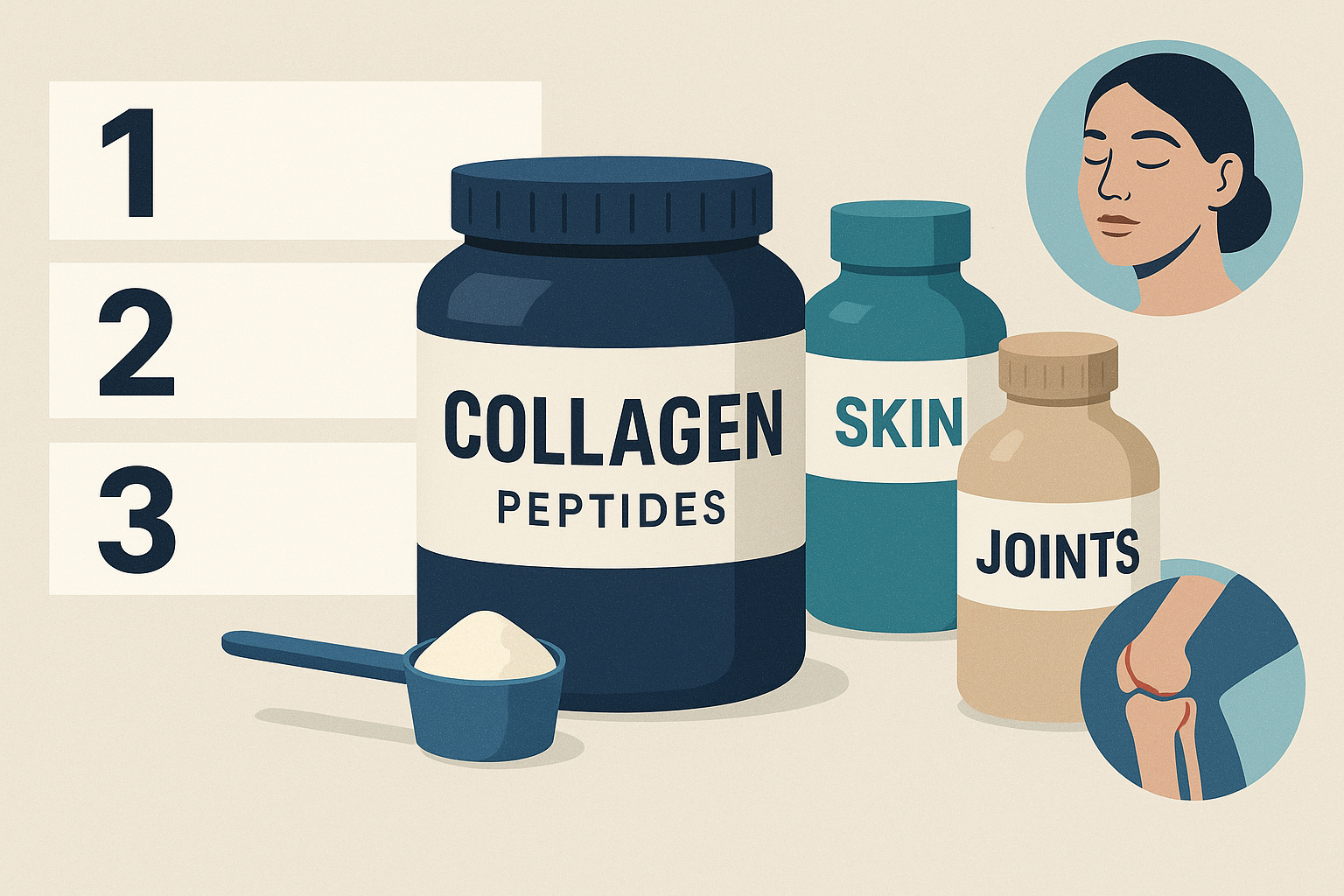
Collagen is the most abundant protein in your body, and production declines steadily from your mid-20s, which is why supplements have become a daily habit for skin, hair, nail, and joint support. The key term is "hydrolyzed" — collagen broken into small peptides your body absorbs more easily. Here's how the main types compare and who each one fits.
1. Hydrolyzed type I & III bovine collagen — best for skin, hair, and nails
Types I and III are the dominant collagens in skin, and hydrolyzed bovine peptides are the most researched for improving skin elasticity, hydration, and nail strength. Grass-fed, pasture-raised sourcing is the quality benchmark.
Best for: Skin elasticity, hydration, hair, and nails.
Watch for: Look for third-party testing and a clear peptide (hydrolyzed) label.
2. Type II collagen — best for joints
Type II collagen is concentrated in cartilage, and undenatured type II (UC-II) in particular has evidence for joint comfort and mobility at very small doses. If your primary goal is joints rather than skin, this is the targeted choice.
Best for: Joint comfort, cartilage, and mobility.
Watch for: UC-II works differently from hydrolyzed collagen and is dosed in milligrams, not scoops.
3. Marine collagen — best for absorption and pescatarians
Marine collagen (from fish skin and scales) is predominantly type I with a small peptide size that's often cited as highly bioavailable. It's the go-to for people who avoid beef and pork.
Best for: Skin support, fast absorption, and pescatarian diets.
Watch for: Can carry a faint fishy taste; choose a reputable, deodorized product.
4. Multi-collagen blends — best all-rounder
Multi-collagen powders combine types I, II, III, and often V and X from several sources, giving broad coverage in one scoop. They're a sensible default if you want both skin and joint support without managing multiple products.
Best for: General coverage across skin and joints.
Watch for: Per-type doses are lower than a single-type product, so targeted goals may need a specialist formula.
Quick comparison
| Type | Source | Best for | Notable feature |
|---|---|---|---|
| Type I & III | Bovine | Skin, hair, nails | Most researched for skin |
| Type II (UC-II) | Chicken cartilage | Joints | Effective at low doses |
| Marine | Fish | Skin, absorption | High bioavailability |
| Multi-collagen | Mixed | All-around | Broad coverage |
How to choose and use collagen
Pick by goal: type I & III bovine or marine for skin, type II for joints, or a multi-collagen blend for both. Hydrolyzed peptides mix easily into coffee, smoothies, or water and are typically taken daily; results for skin and nails usually take eight to twelve weeks of consistent use. Pairing collagen with vitamin C supports the body's own collagen synthesis. GLP-1 users who are eating less often use collagen as an easy way to add protein without volume.
Frequently asked questions
What is the best collagen for skin? Hydrolyzed type I and III collagen — from grass-fed bovine or marine sources — has the most research behind skin elasticity and hydration benefits.
Does collagen really work? Studies on hydrolyzed collagen show modest improvements in skin elasticity, hydration, and joint comfort with consistent daily use over several weeks. It's a support supplement, not a cure, and quality and consistency matter.
Is collagen good for GLP-1 users? Many GLP-1 users add collagen because it's an easy, low-volume way to increase daily protein when appetite is reduced, helping protect muscle and support skin during weight loss.
The best collagen peptide is the one matched to your goal and verified by third-party testing. For skin, that's hydrolyzed type I & III or marine; for joints, type II; and a multi-collagen blend covers both.
This article is for general educational purposes only and is not medical advice. Consult your doctor before adding any supplement, especially if you are pregnant, nursing, have an allergy, or take medication.