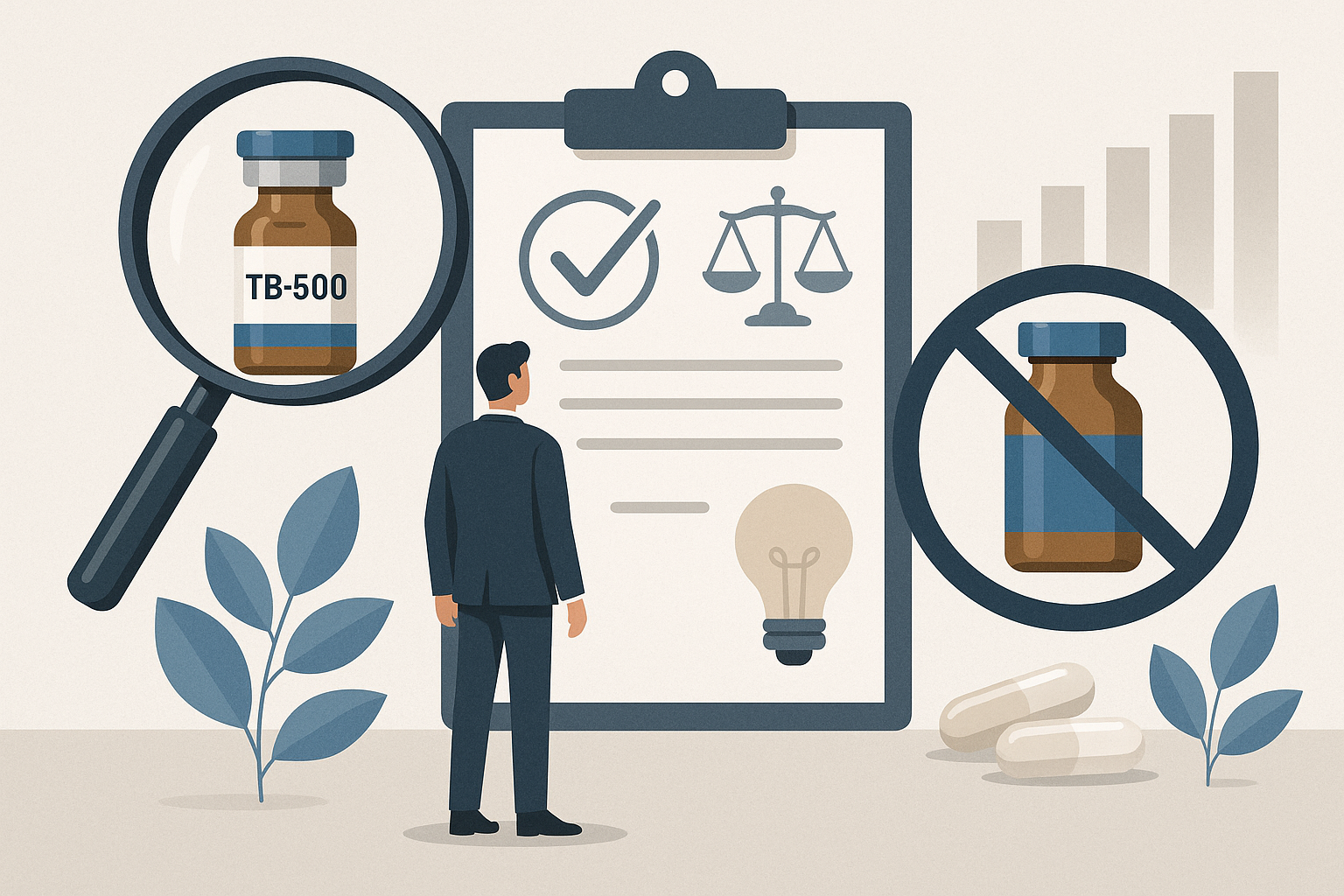
Searches for "TB-500 supplements" keep rising as people look for help with soft-tissue recovery and joint comfort. But there is an important reality behind the hype: TB-500 (a synthetic fragment related to thymosin beta-4) is not sold as a legal supplement. It is marketed as a research chemical, has not been approved by the FDA for human use, and is prohibited by the World Anti-Doping Agency. Buying and self-administering it carries real legal, safety, and purity risks.
This guide explains what TB-500 actually is, why "TB-500 supplements" are a gray area, and the legal, evidence-supported alternatives that target the same recovery goals.
This is educational information, not medical advice. It is not an endorsement to purchase or use unapproved peptides. Always consult a licensed healthcare provider before starting any supplement or recovery protocol.
Why "TB-500 supplements" don't really exist legally
A legal dietary supplement must contain ingredients permitted for use in supplements and be sold for human consumption with proper labeling. TB-500 fails that test:
- It is unapproved. The FDA has not approved TB-500 for human use, and it is not a recognized dietary ingredient.
- It is sold "for research only." That labeling exists specifically to sidestep consumer-safety regulation — these vials are not made to pharmaceutical or supplement quality standards.
- Purity is unverified. Research-chemical peptides have been found mislabeled or contaminated, with no COA you can trust.
- It is banned in sport. Tested athletes risk sanctions.
In short, anything marketed to you as a consumable "TB-500 supplement" should be treated with serious caution.
The best legal alternatives for recovery support
If your goal is the outcome people associate with TB-500 — supporting tissue repair, joint comfort, and recovery — these legal, widely available options have far better safety and quality profiles:
1. Collagen peptides (hydrolyzed collagen)
The most direct legal "peptide" supplement. Collagen peptides are well-studied for joint comfort and connective-tissue support and are sold as food-grade, third-party-tested powders.
2. Omega-3 fish oil (EPA/DHA)
Strong evidence for supporting a healthy inflammatory response, which underpins recovery. Look for IFOS-certified, third-party-tested products.
3. Curcumin (turmeric extract)
A widely studied botanical for joint comfort and exercise-recovery support; choose bioavailability-enhanced, tested forms.
4. Vitamin C
Essential cofactor for collagen synthesis — foundational for connective-tissue repair and cheap to supplement.
5. Creatine monohydrate
One of the most-researched, safest sports supplements; supports strength, lean mass, and training recovery.
6. Glycine and proline
Amino acids that serve as building blocks for collagen and connective tissue; often paired with vitamin C.
7. Tart cherry extract
Studied for reducing exercise-induced muscle soreness and supporting sleep, which aids recovery.
8. Whey or quality protein
Adequate protein intake is the real foundation of muscle and tissue repair — more impactful than any exotic compound.
A safer recovery framework
Before reaching for anything experimental, optimize the fundamentals that actually drive recovery:
- Protein and total calories to give tissue the raw materials.
- Sleep — the single most powerful recovery tool.
- Progressive loading and rest rather than pushing through injury.
- Legal, third-party-tested supplements from the list above.
- Professional care — a sports-medicine physician or physical therapist for persistent injuries.
Frequently asked questions
Is TB-500 legal to buy?
It is sold only as a "research chemical," not as an approved drug or dietary supplement, and is not legal to market for human consumption. Possession and use for self-administration fall into a legal and safety gray zone, and it is banned in tested sport.
Are there legal peptide supplements?
Yes — collagen peptides are a legal, food-grade peptide supplement with real evidence for joint and connective-tissue support. They are the most defensible "peptide" choice for recovery.
What should athletes use instead?
Stick to legal, tested supplements (collagen, omega-3s, creatine, protein) and recovery fundamentals. Anything on the WADA prohibited list risks your eligibility and your health.
Bottom line: skip "research-only" TB-500 products. The legal, third-party-tested alternatives above target the same recovery goals with far less risk — and the biggest gains still come from protein, sleep, and smart training.